

Market Order vs. Limit Order: The Hidden Costs Most Traders Overlook
When evaluating portfolio performance, most retail traders focus on just two numbers on the screen: whether a trade won or lost, and by what percentage. Smaller cost factors — such as order type, entry timing, or token liquidity at the time of execution — are routinely ignored.
Yet if you trade with any regularity, these seemingly negligible costs accumulate over time and carve out an enormous gap in long-term profitability. Understanding the fundamental difference between a Market Order and a Limit Order is one of the core practical skills that lets you keep as much of your money as possible.
How Are Market Orders and Limit Orders Different?
Market Order
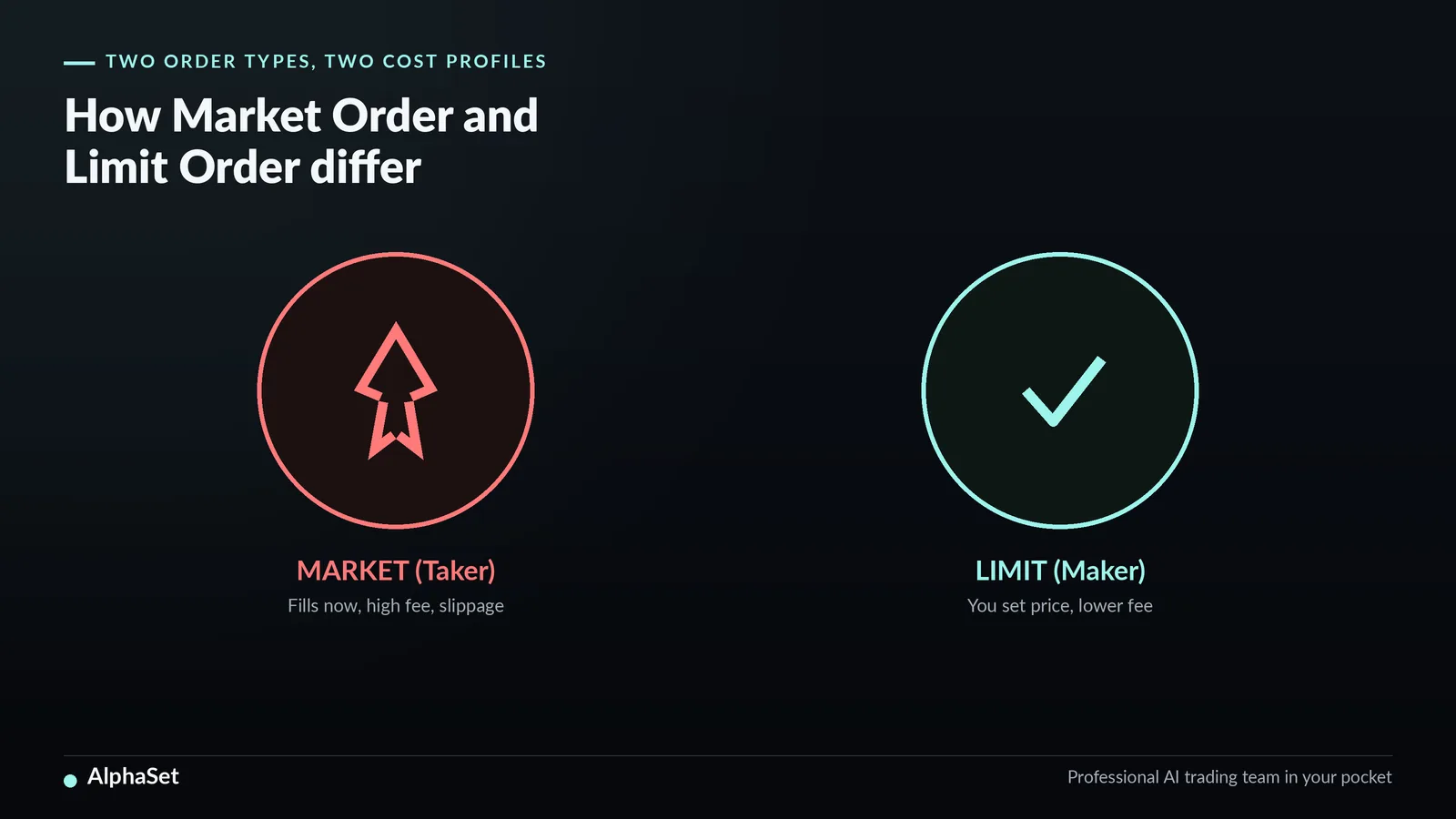
A Market Order requests immediate execution at the best available price on the market. Because you want to fill instantly, you are actively taking liquidity that already exists on the exchange's Order Book. As a result, you are classified as a Taker and charged a higher trading fee.
Limit Order
A Limit Order requests execution only when the market price reaches a specific level you have set in advance. Your order sits on the Order Book and waits to be matched. This behavior means you are adding liquidity to the exchange. As a result, you are classified as a Maker and enjoy a significantly lower trading fee — and on some exchanges you even receive a Maker Rebate for helping deepen the Order Book.
The Impact of Slippage
Slippage is the difference between the price you see when you place an order and the price at which your order actually gets filled. It occurs most frequently when you use a Market Order in a thin-liquidity market.
Example: You want to use a Market Order to immediately buy $10,000 USDT worth of Solana (SOL). At the moment you hit the button, the displayed price is $100. However, the exchange's actual Order Book is structured as follows:
- Only $3,000 USDT worth of SOL is available at $100.00.
- The next $3,000 USDT worth of SOL is offered at $100.05.
- The remaining $4,000 USDT worth of SOL is offered at $100.12.
When you submit the Market Order, the exchange sweeps upward through the book to fill your full $10,000 USDT. Your order gets matched at three different price levels, pushing your effective average purchase price to $100.06 instead of the $100.00 you expected. That 0.06% gap is your slippage cost.
For large-cap assets like BTC or ETH, slippage on small orders is negligible because the Order Book is very deep. But for altcoins, a single Market Order of just $10,000–$50,000 USDT can immediately incur slippage of 0.3%–1%, or even several percent during periods of high volatility.
The Compounding Real Cost of Using Market Orders
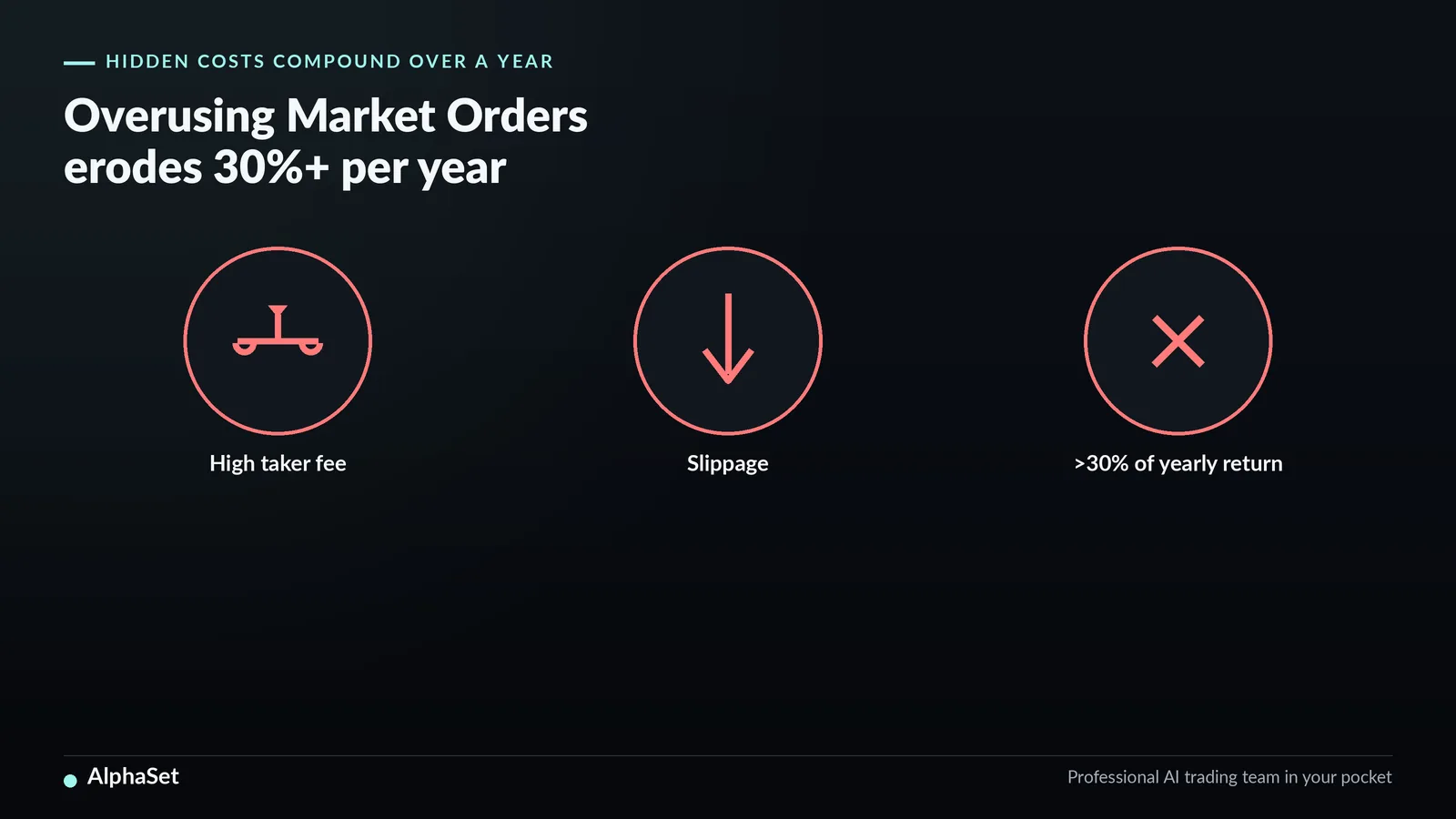
Beyond slippage, Market Orders also carry a taker fee — typically 0.04%–0.1% on major exchanges. Limit Orders typically carry a much lower maker fee of 0.01%–0.02%, or even a negative rebate (you get paid) on exchanges that incentivize liquidity provision.
With a trading strategy of 200 orders per year, the difference between a 0.08% taker fee and a 0.02% maker fee is 0.06% × 200 orders = 12% in fees per year. Add an average slippage of 0.1% per order and that's another 20%. This means that regardless of how good or bad your actual strategy is, simply overusing Market Orders indiscriminately can hand over more than 30% of your annual portfolio performance straight to the exchange.
Limit Orders Aren't Always Better
Limit Orders carry the risk of non-execution if the price never reaches your specified level.
In a fast-moving market, if you place a Limit buy order just 0.1% below the current price, the price may never pull back that far — and the token keeps rallying while you hold no position. This is a trade-off that must be weighed situationally: speed and execution certainty (Market Order) versus better pricing and lower fees at the risk of missing the move (Limit Order).
Alpha Crypto: Algorithmically Optimizing Order Type Based on Real Market Conditions
What Is Alpha Crypto?
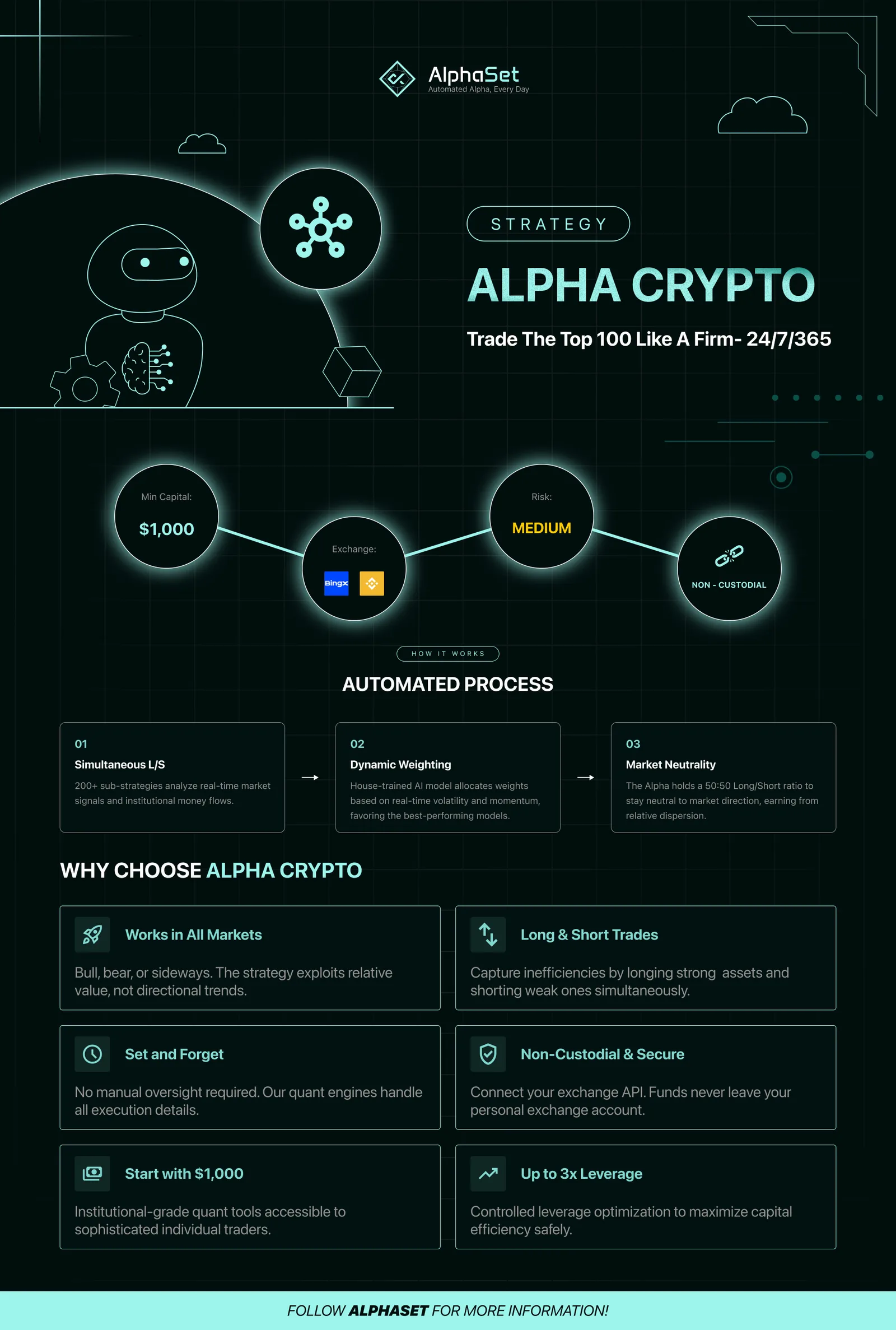
Alpha Crypto is AlphaSet's automated long/short trading strategy across the top 100 coins by market cap. AlphaSet is a quantitative investment platform designed for individual investors.
Rather than simply buying and holding, Alpha Crypto scores all 100 coins, buys the strongest, and short-sells the weakest — allowing you to profit in both market directions instead of waiting for prices to rise.
- The long/short ratio is automatically adjusted to current market conditions, driven entirely by data and free from emotional bias.
- Everything runs automatically 24/7 via API on your own exchange account. Your capital remains on the exchange at all times; AlphaSet has order-execution rights only — no withdrawal access.
Alpha Crypto Optimizes Order Type and Timing to Real Market Conditions
To definitively solve the hidden cost problem without sacrificing high-quality opportunities, Alpha Crypto prioritizes Limit Orders to maximize the benefit of low Maker fees and minimize slippage on your account. However, when multiple indicator groups simultaneously shift into extreme signal strength (high momentum) and the system needs to enter a position immediately before a price breakout, the engine flexibly switches to Market Orders. Orders are split into smaller tranches to reduce market impact and optimize the average entry price.
The engine is never driven by FOMO, and emotions never influence order-type decisions. Manual traders tend to reach for Market Orders out of a feeling of "I need to get in right now" — after hesitating and watching the price already move up. That is precisely when Market Orders are used most and slippage is highest, because the market is already volatile and immediate liquidity is too thin.
Every unnecessary 0.1%–0.5% in extra costs will gradually erode your returns. With AlphaSet's investment solution, however, your entire capital and assets remain 100% secure in your personal exchange account at all times.
AlphaSet connects securely via an API gateway solely to execute automated orders. You pay a fixed monthly subscription fee and keep 100% of the profits — there are no performance fees.
Ready to outperform with AlphaSet?
Activate the AlphaSet strategy today and let our quants manage your exchange sub-accounts automatically.
Activate Alpha Crypto