

The Real Win Rate of Retail Traders: What Do the Numbers Actually Say?
In the crypto investment community, it's easy to be surrounded by spectacular success stories: someone who bought Solana (SOL) at $10 and took profit at $200, or a trader flaunting a screenshot of a Futures account that grew 10x in just three short months. These stories are completely real — but they represent only the tip of the iceberg, accounting for a vanishingly small fraction of the full picture.
The actual data from major exchanges and independent research tells a very different story. Looking these numbers squarely in the face isn't meant to discourage you — it's meant to equip you with a more grounded, clear-eyed mindset.
The Numbers That "Speak for Themselves" from Exchange Data
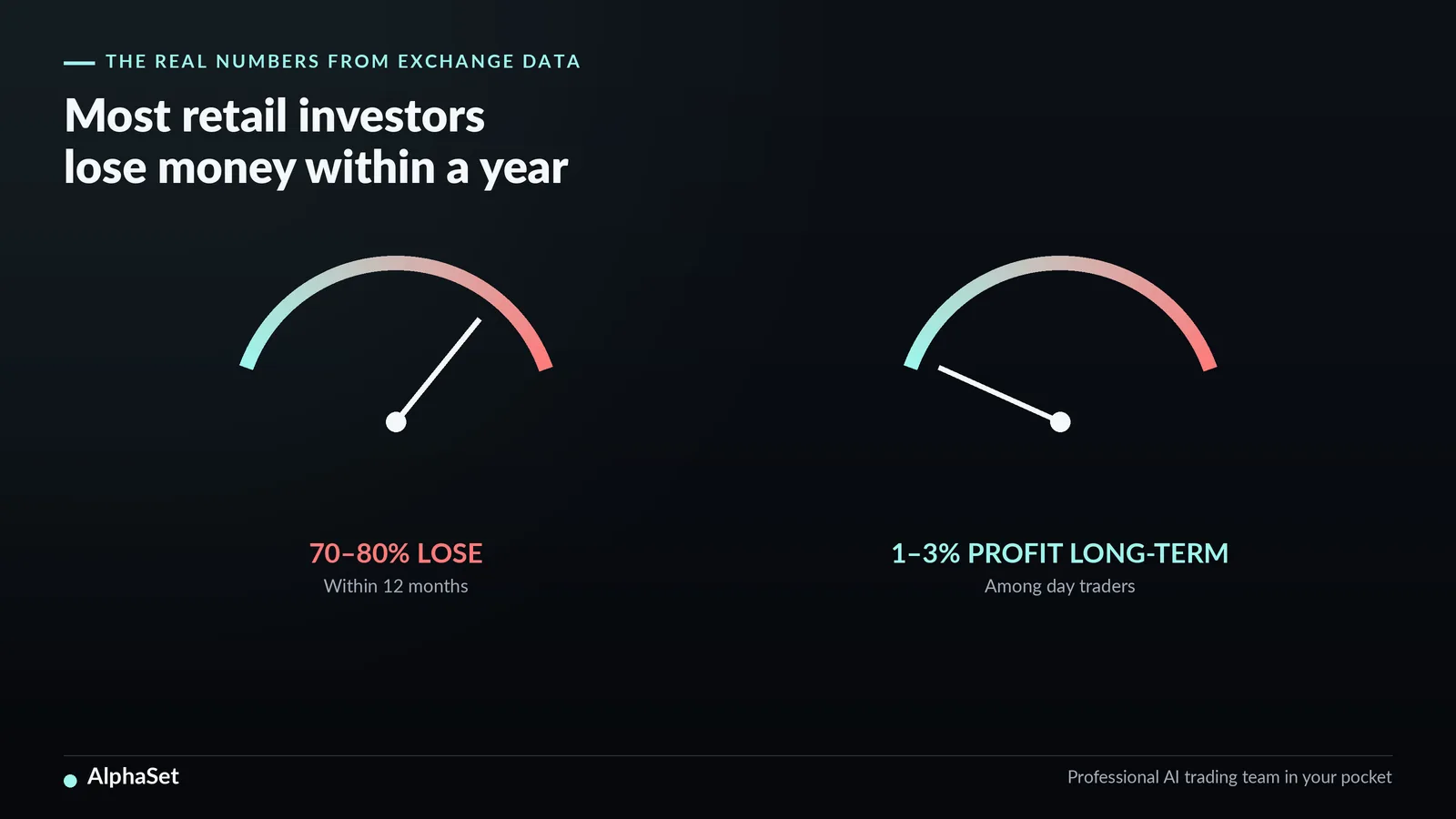
In many countries, major futures exchanges publish data on the ratio of profitable to losing accounts in their disclaimer disclosures. The average figure consistently hovers around the same range: 70% to 80% of retail trader accounts lose money over any rolling 12-month period.
Looking at a landmark study from Brazil's stock market — where day trading activity is tracked most rigorously — the results are even more sobering: among those who persisted with day trading for more than one year, only 1% to 3% managed to generate genuinely sustainable profits after accounting for all costs. In a market characterized by high volatility and elevated leverage like crypto, the actual loss rate for retail investors is likely even higher than in traditional equity markets.
The reason you still see so many profit-flexing posts around you comes down to the Survivorship Bias psychological trap. Those who suffer heavy losses tend to go quiet and silently exit the game — dropping out of the statistical sample entirely — which leads the crowd to mistakenly believe that this market is easy money.
High Loss Rates Are a Structurally Predictable Outcome
This reality exists because of the structural barriers built into the market itself.
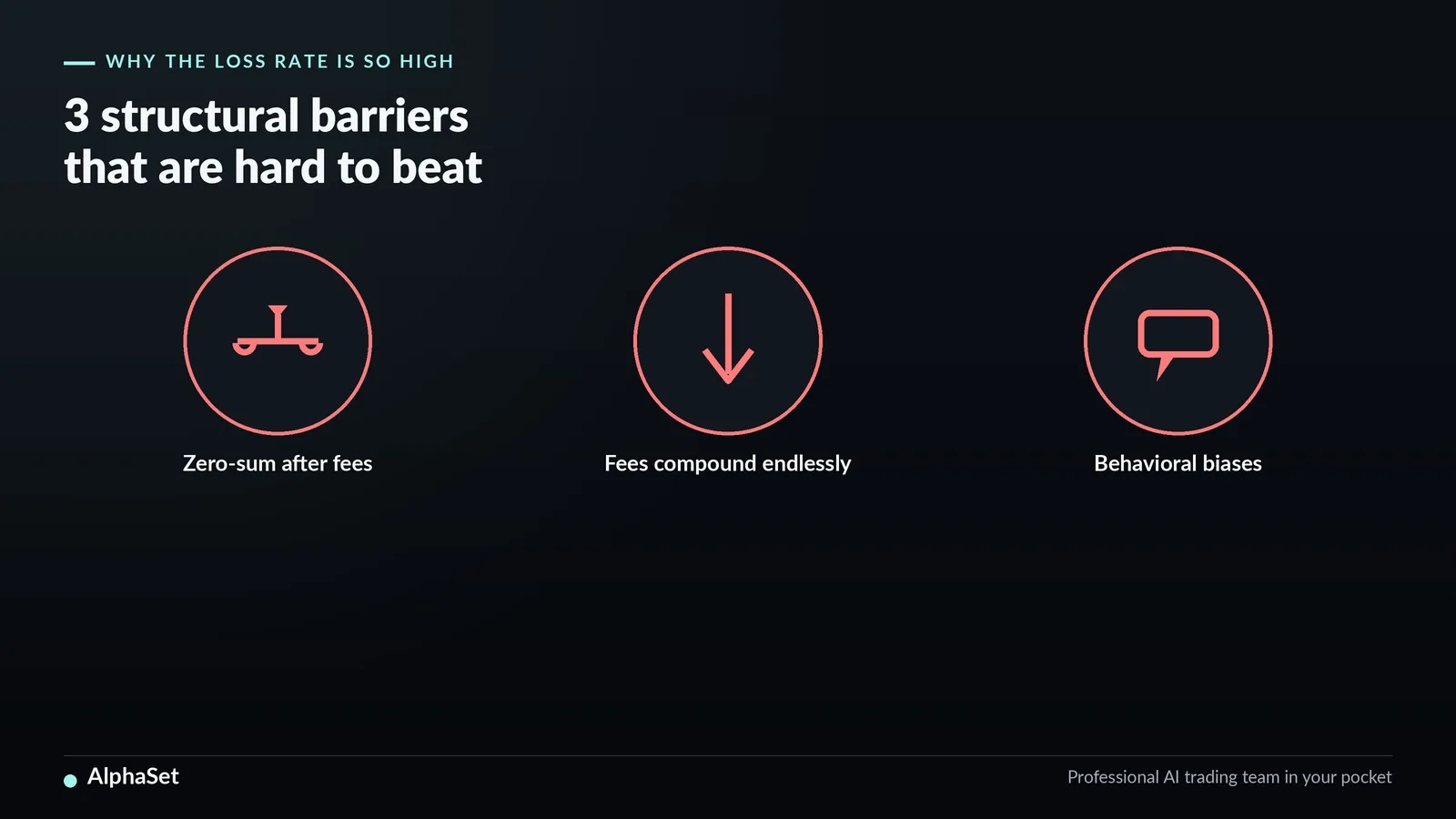
First, total market profit is zero-sum after fees. In the short term, after deducting transaction costs, the money you win is essentially the money lost by someone on the other side of the trade. When your counterparties are large funds running high-frequency trading (HFT) algorithms with superior speed and data infrastructure, you are entering a game where the opponent holds an overwhelming structural advantage.
Second, transaction fees accumulate relentlessly. The more a trader trades, the more fees they pay — and the bulk of those fees go to the exchange and market makers. The Barber & Odean (2000) study of the U.S. stock market found that the most active traders underperformed the market by the widest margin once fees were deducted.
Third, and most critically, are behavioral biases. Human beings are not computers. We find it extremely difficult to switch off natural emotional reflexes such as loss aversion, overconfidence, FOMO, and anchoring. These biases affect everyone to varying degrees. Knowing about them in theory does not translate into the ability to eliminate them in practice when facing a real-money decision in the moment.
So What Do Consistently Winning Traders Actually Do?
Professional traders who have survived multiple downtrend cycles tend to share several common traits: they can explain their entries mathematically and with data, rather than relying on gut feel; they have a consistent decision-making framework that doesn't depend on short-term emotions; they manage risk rigorously and never allow a single position to wipe out all prior gains; and they continuously improve based on real performance data.
The single biggest difference between professionals and amateurs isn't knowledge — it's consistency. Most people can recite the theory by heart, but when they're standing in front of a live screen, they let emotion dictate their behavior.
Executing Iron Discipline to Break the Cycle of Mistakes
What Is Alpha Crypto?
Alpha Crypto is AlphaSet's automated long/short trading strategy operating across the top 100 coins by market cap. AlphaSet is a quantitative investment platform built for retail investors. Unlike simply buying and holding, Alpha Crypto scores all 100 coins, goes long on the strongest and short on the weakest — enabling you to generate returns in both market directions rather than just waiting for prices to rise. The long/short ratio adjusts automatically based on market conditions, driven entirely by data with no emotional interference. The entire system runs automatically 24/7 via API on your exchange account; your capital remains on the exchange at all times, and AlphaSet has order-placement rights only — never withdrawal rights.
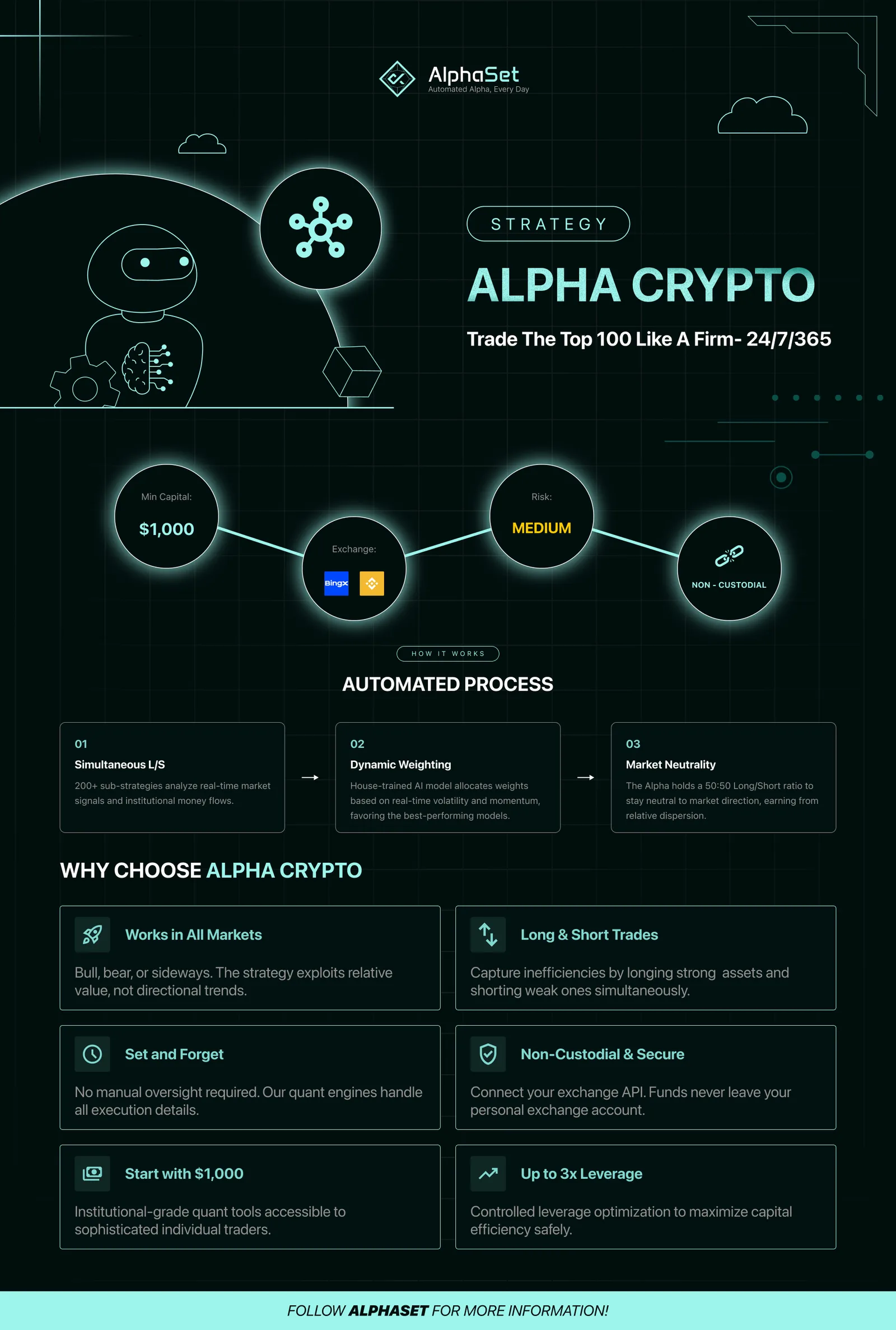
Alpha Crypto Executes the Discipline Retail Traders Cannot Consistently Maintain
AlphaSet is a quantitative investment platform that connects via API to your exchange account. Alpha Crypto is built to address precisely the structural problems that drive retail traders' high loss rates: every decision is made purely on data and expected value — never on emotion. There are no "revenge trades" after a loss. No oversizing because of overconfidence after a winning streak. No holding losing positions too long due to anchoring. No cutting winning trades too early out of fear of giving back open profits.
Every wrong decision in trading doesn't just cause an isolated loss — it triggers a chain of psychological consequences. Losing a trade → the urge to win it back → entering a position larger than planned → losing more → psychological instability → the next decision being even worse. The engine has no such psychological feedback loop.
The system eliminates behavioral errors like letting losses run or FOMO-buying at the top. When indicators hit the stop-loss threshold, the order is executed immediately — within milliseconds — with no hesitation and no emotional expectation.
The fixed monthly subscription fee is substantially lower than the average amount a retail trader loses in a single year. And all the profits are yours — there is no performance fee.
Ready to outperform with AlphaSet?
Activate the AlphaSet strategy today and let our quants manage your exchange sub-accounts automatically.
Activate Alpha Crypto