

Why Does the Top 100 Token List Keep Changing?
If you open CoinMarketCap today and compare it to the top 100 list from three years ago, the turnover will surprise you. Many tokens that once sat in the top 20 are no longer in the top 100 — or have stopped trading altogether. New names that didn't exist three years ago now occupy those spots.
This brutal selection process is not a random phenomenon. There are very specific economic and technological mechanisms that explain why the lifecycle of crypto projects is far shorter and more volatile than that of the top 100 stocks or the world's 100 largest companies. Understanding this dynamic will fundamentally change how you think about building and managing your investment portfolio.
The lifecycle of a crypto project is far shorter than a traditional company
A large company has thousands of employees, physical assets, long-term contracts, and massive fixed costs. For a major company to fail, it takes years of consecutive poor decisions. The process is slow and usually comes with many early warning signs.
A crypto project may have a team of only a few dozen people, no significant physical assets, and its entire "value" rests on narrative, community, and expectations about the future. When the narrative fades, or expectations go unmet, that value can evaporate very quickly — sometimes within a matter of months.
On top of that, the crypto space evolves at an extraordinary pace. A new technology can render an existing project's approach entirely obsolete. Ethereum's Layer 2 solutions have significantly reduced demand for certain competing Layer 1 blockchains. Blockchains designed to solve the problems Ethereum had in 2021 may no longer be relevant now that Ethereum has improved substantially through 2023–2024.
Common reasons tokens fall out of the top 100
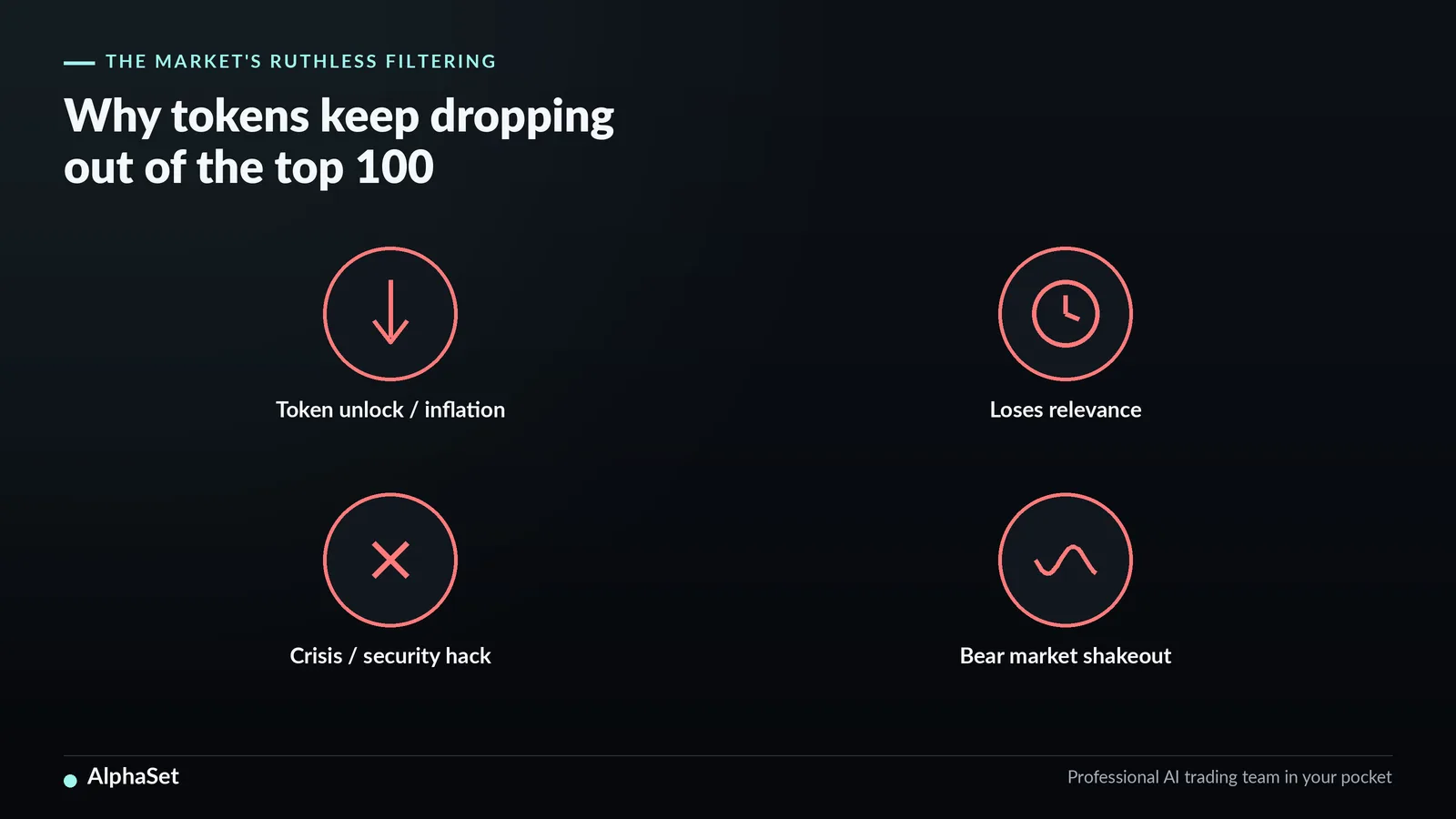
First, selling pressure from token unlocks and vesting schedules. Many projects launch with a very small circulating supply, making it easy to push prices higher. However, once large token unlock events begin releasing allocations to early-round investors and the development team, persistent selling pressure hits the market while demand remains unchanged — leaving the token price with only one direction to travel. When a project has highly inflationary tokenomics, token dilution and a drop in rankings are only a matter of time.
Second, loss of relevance and mindshare. In a fast-moving space, projects that fail to evolve are routinely displaced by newer ones solving the same problem more effectively. First-generation Layer 1 blockchain tokens (EOS and TRON during 2018–2019) gradually lost their standing as competition from newer blockchains intensified.
Third, internal crises and security vulnerabilities. When founding teams fall into disputes, face fraud allegations, or — most critically — smart contract vulnerabilities are exploited by hackers to drain tens of millions of dollars, community trust collapses immediately. A token can lose 70%–90% of its value within days and rarely recovers to its previous all-time high.
Finally, the bear market filter. In a bull market, nearly every token rises, and it becomes difficult to distinguish genuinely valuable projects from pure hype. Bear markets eliminate projects with no real users, no real revenue, and teams lacking the commitment to keep building when conditions get tough.
Today's top 100 is not guaranteed to be tomorrow's top 100
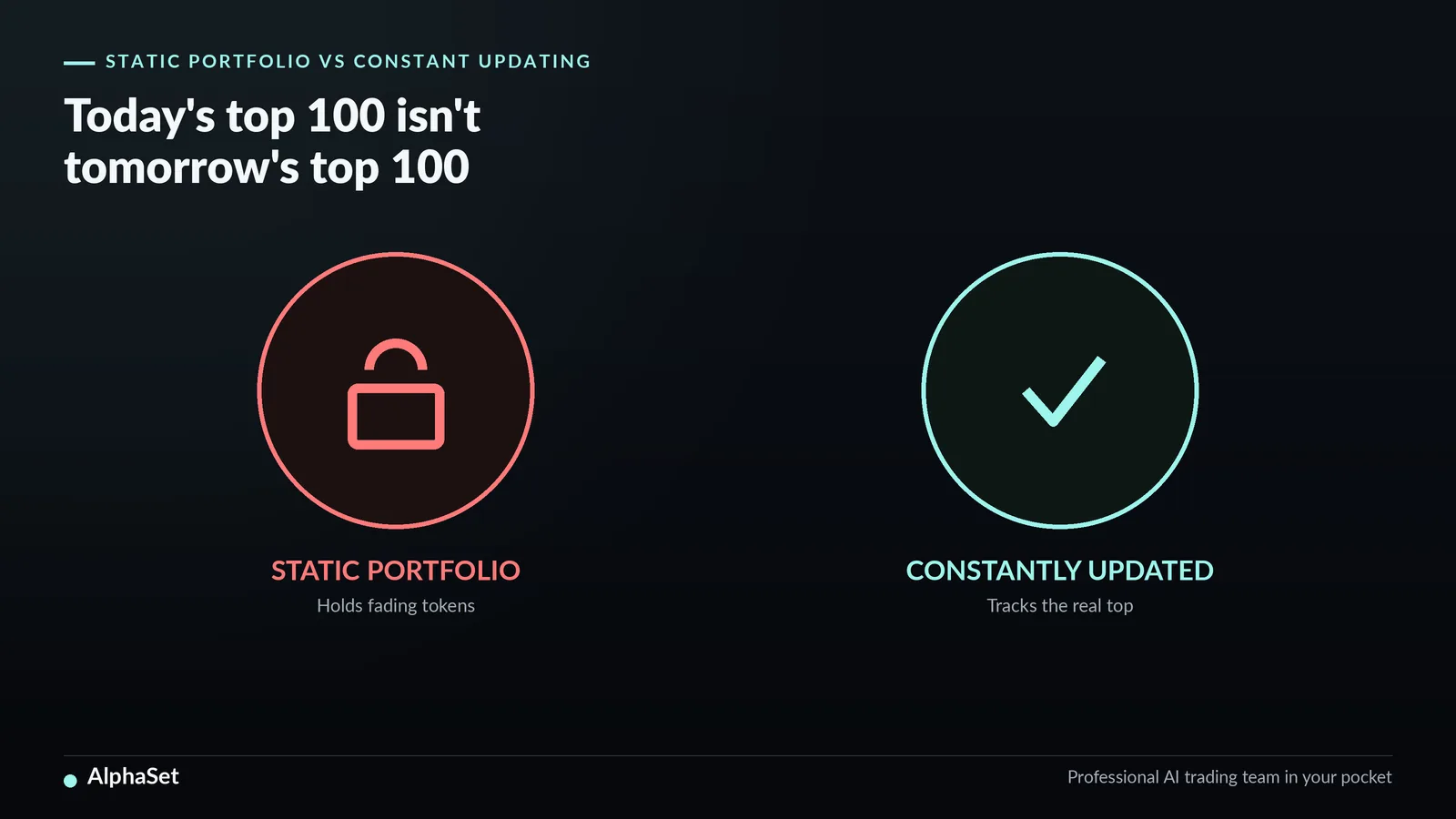
The list of "top" tokens changes constantly. If you buy a basket of top 50 tokens and never update it, you end up holding tokens that are sliding down the rankings while missing the ones climbing up. As a result, the performance of a static portfolio typically lags a regularly rebalanced one.
This also means a mechanism is needed to detect early signs of a weakening token: declining on-chain activity, less active development, underperforming relative strength within its peer group, and gradually shrinking trading volume. Waiting until a token has already dropped out of the top 100 before reacting is, more often than not, too late.
Continuously tracking 100 tokens with a high-performance system
Monitoring the health of 100 tokens simultaneously — tokenomics, on-chain data, performance, team and community activity — is an enormous workload to handle manually. The crypto market moves too fast for a once-a-week check. Even with sufficient data, the decision to "sell the weakening token and buy the one entering the top" demands a high level of discipline: avoiding the psychological pull of anchoring to a purchase price or dwelling on a wrong pick.
What is Alpha Crypto?
Alpha Crypto is an automated long/short trading strategy across the top 100 largest coins in the market, offered by AlphaSet — a quantitative investment platform for individual investors.
Rather than simply buying and holding, Alpha Crypto scores all 100 coins, goes long on the strongest and short on the weakest, allowing you to generate returns in both market directions instead of waiting for prices to rise.
The long/short ratio is adjusted automatically based on market conditions, driven entirely by data and free from emotional influence. Everything runs automatically 24/7 via API on your exchange account — your capital stays on the exchange, and AlphaSet has order-placement rights only, with no withdrawal access.
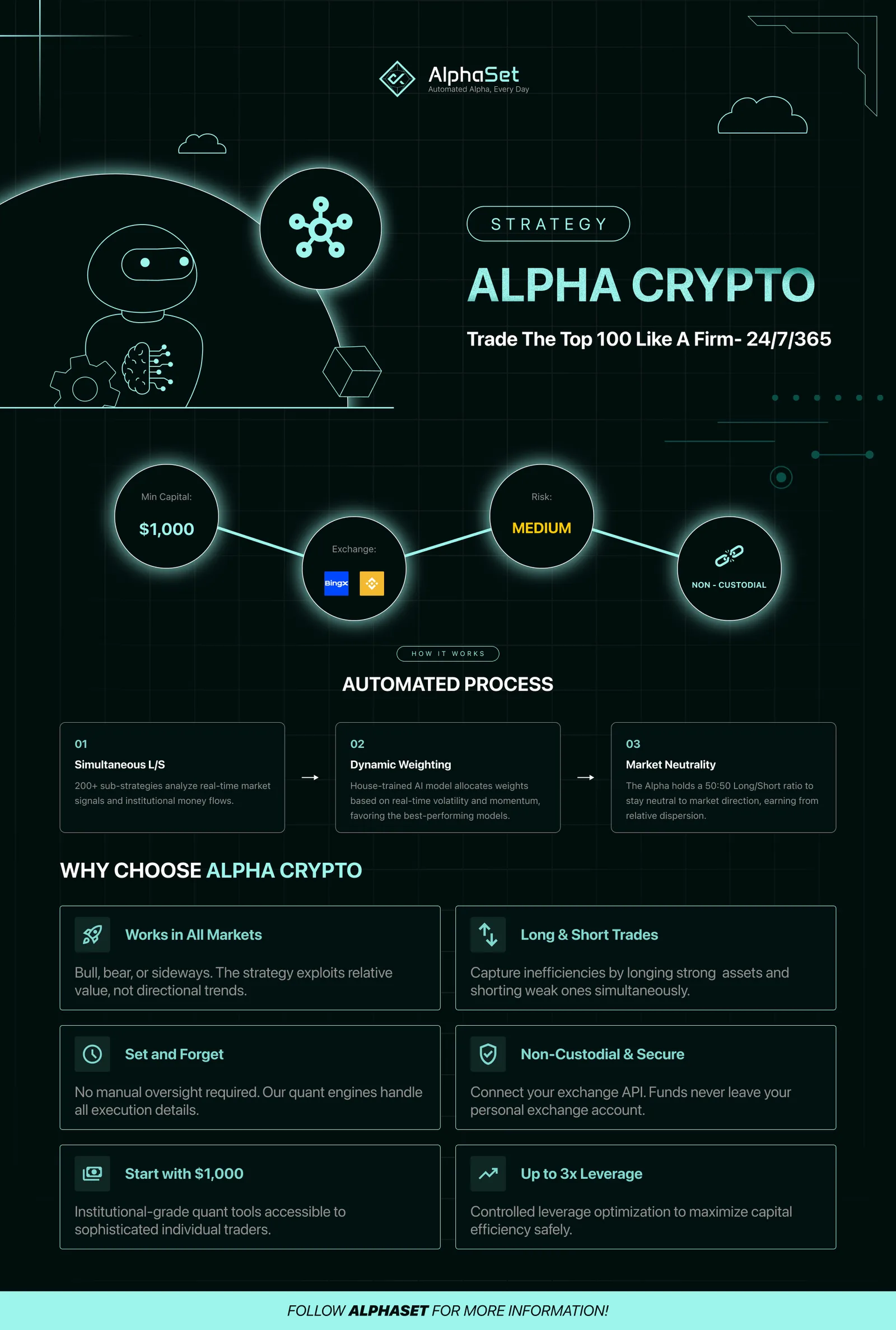
Alpha Crypto automatically updates the top 100 list and closes positions when tokens drop out of the rankings
AlphaSet is a quantitative investment platform that connects via API to your exchange account. Alpha Crypto tracks the top 100 token list in real time. When a token falls out of the top 100 or shows signs of deterioration across multiple signal dimensions — declining relative strength, falling on-chain activity, weakening volume — its score drops and the position is automatically adjusted or closed.
Conversely, when a new token enters the top 100 and begins demonstrating strength across multiple signals, the engine evaluates it for inclusion in the long portfolio. The list is not fixed; it reflects the actual state of the market at any given moment.
What the engine does that humans struggle to do consistently is this: it never anchors to a token simply because it was purchased earlier. When signals deteriorate, the position is closed as planned — independent of the feeling that "it's a shame I bought at a higher price" or "I should wait to break even." Nor does it miss newly ranked tokens because they're "unfamiliar" or "not researched enough" — the engine evaluates every token through the same consistent framework.
Every instance of holding a weakening token due to anchoring generates significant opportunity cost — capital trapped in a declining asset while better opportunities exist elsewhere. AlphaSet's fixed monthly subscription fee is far lower than that opportunity cost over time. And all profits are yours — there is no performance fee.
Ready to outperform with AlphaSet?
Activate the AlphaSet strategy today and let our quants manage your exchange sub-accounts automatically.
Activate Alpha Crypto