

Multi-factor model: how to combine multiple signals to pick better stocks
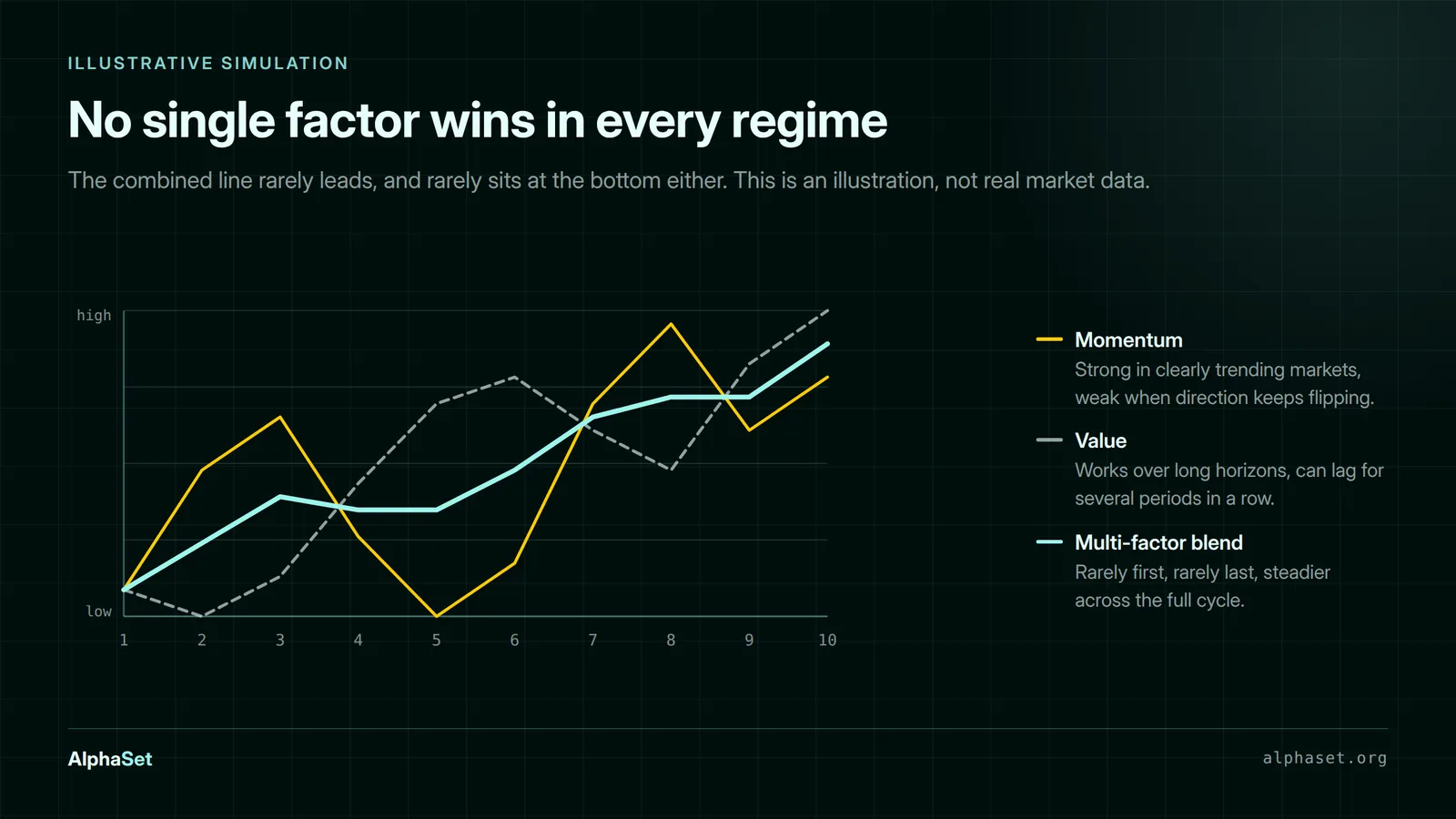
In academic finance research, no single factor consistently predicts stock performance forever. Momentum works well across many periods, but breaks down under certain market conditions. Low valuation is effective over the long run, but can underperform for years in a row. This is why modern investment systems have shifted to multi-factor models.
What is a multi-factor model?
A multi-factor model is a method for evaluating and selecting stocks based on multiple independent factors simultaneously, rather than relying on a single criterion.
Five common factor groups include:
-
Momentum: recent upward price trend
-
Valuation: current price relative to intrinsic value and sector peers
-
Quality: balance sheet health and sustainable profitability
-
Growth: revenue and earnings growth rate
-
Low volatility: price fluctuation below the broader market average
Each factor has its own theoretical foundation and empirical evidence. When combined, the composite model is typically more stable and less dependent on specific market conditions than any single factor alone.
Why is multi-factor better than single-factor?
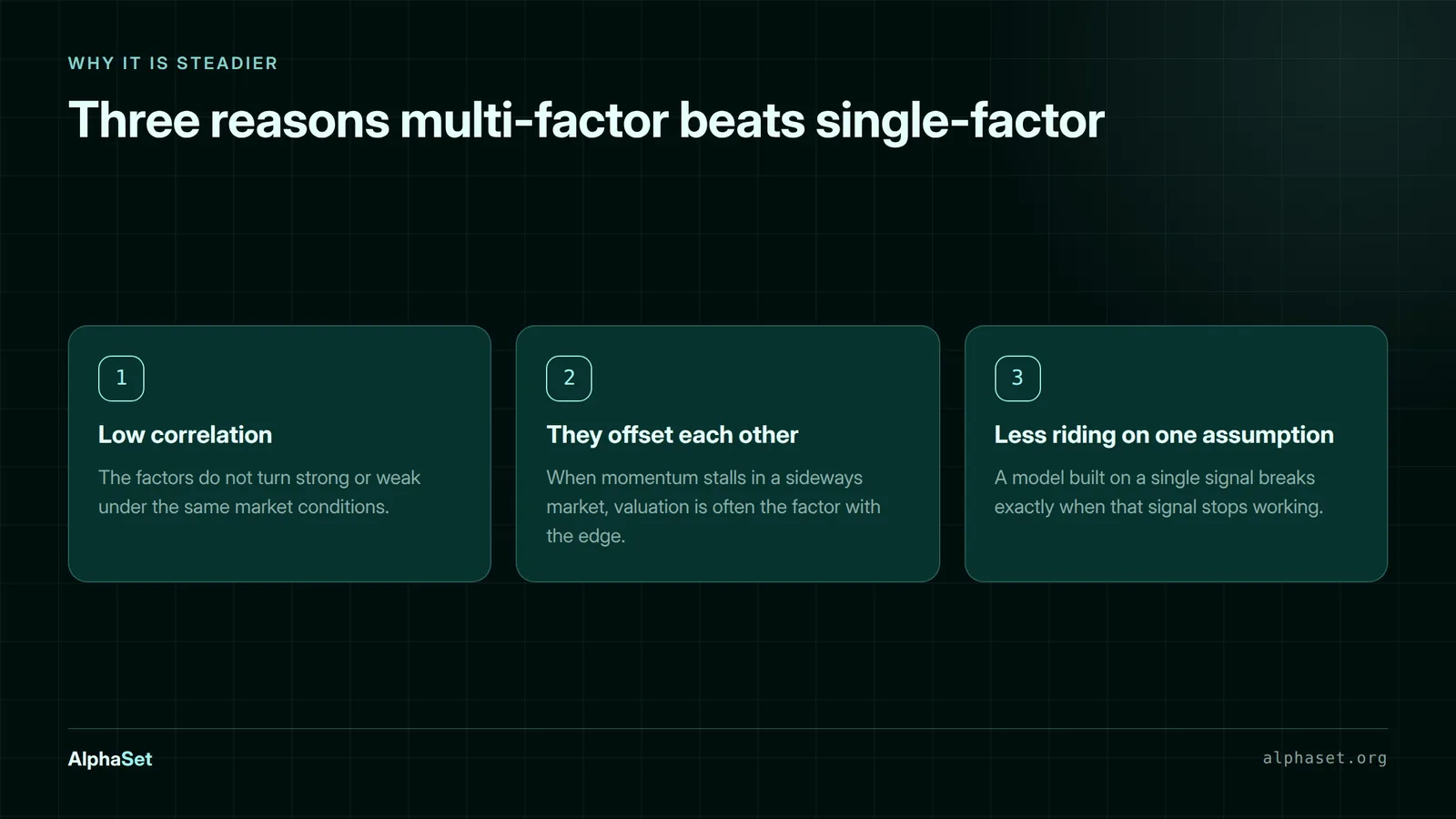
Factors tend to have low correlation with one another, meaning they do not succeed or fail under the same conditions at the same time. When momentum is weak during a sideways market, value may be outperforming. This combination produces more stable performance across varying market cycles.
This is why the world's largest quantitative investment funds almost universally use multi-factor models rather than betting everything on a single signal.
Can you build a multi-factor model on your own?
To build an effective multi-factor model yourself, you need to tackle three problems:
-
Data collection and cleaning: Five factor groups across one hundred tickers means five hundred data points to update each period, with each group sourced from a different provider at a different publication frequency.
-
Proper normalization: If this step is done incorrectly, the multi-factor model will perform worse than a single-factor model, because you are adding together things that cannot simply be added.
-
Calibration for local market characteristics: This is where mistakes are most common. Applying a model built for developed markets directly to the Vietnamese market typically yields poor results — liquidity here is lower, price swings are wider, the investor base is structurally different, and the factors do not operate with the same intensity as in the markets where they were originally studied.
Alpha Stock VN: a multi-factor model built for the Vietnamese market
What is Alpha Stock VN?
Alpha Stock VN is AlphaSet's quantitative investment strategy for the Vietnamese stock market — AlphaSet being a quantitative investment platform designed for individual investors.
The AlphaSet team has more than 10 years of experience developing quantitative trading strategies, has previously managed $80 million for funds in Dubai, UAE, and has processed over $200 million in assets across multiple market cycles with more than $10 billion in live trading volume since 2016.
AlphaSet serves traders ranging from professional to semi-professional participating in digital asset markets (spot/futures/XAU) and the Vietnamese stock market, enabling individual users to trade automatically with impressive real-world APR.
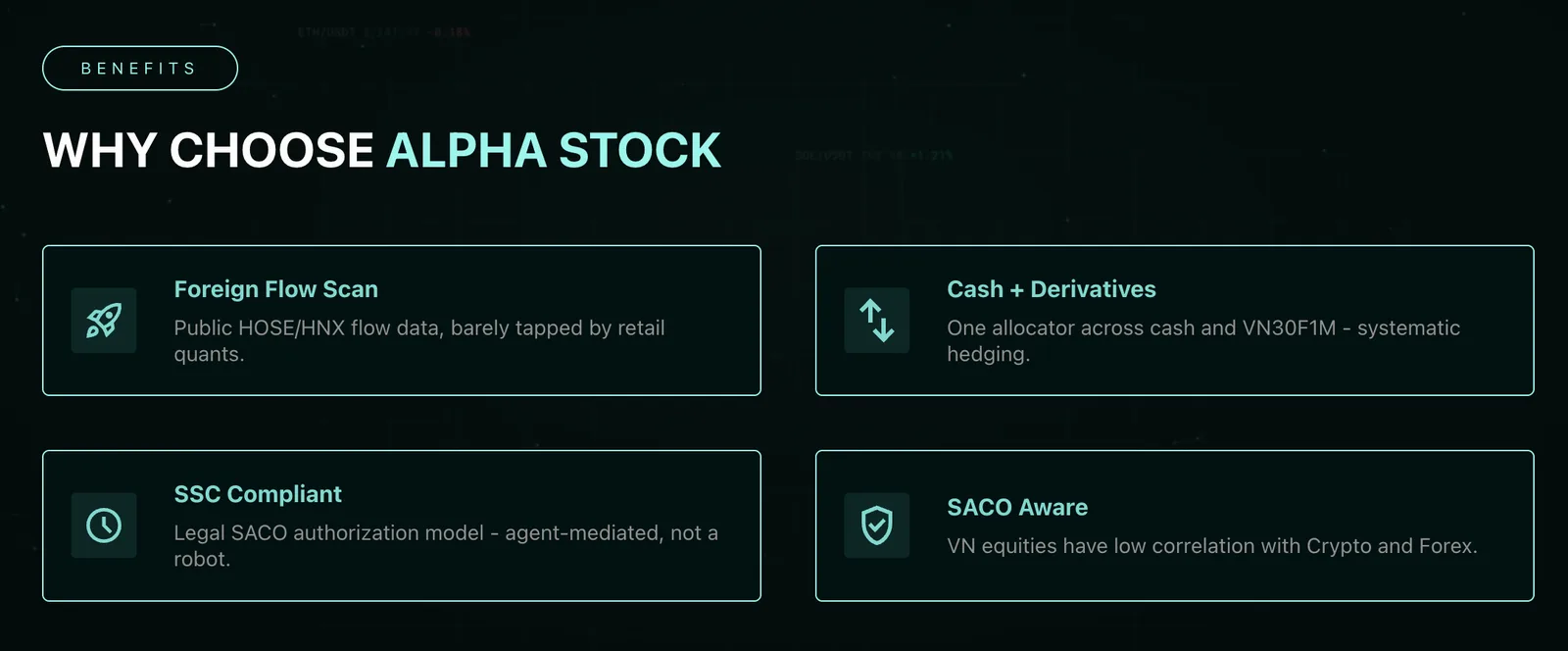
Users need no coding knowledge, no complex setup, and no constant chart-monitoring to trade effectively with AlphaSet. Simply connect AlphaSet to your brokerage account via API, select the AlphaStock strategy, and let the system trade automatically 24/7.
Unlike buying and holding on your own, Alpha Stock VN scores and ranks tickers in the VN30/VN100 universe using a multi-factor system, prioritizing stocks that are backed by significant capital flows, while using VN30F1M futures contracts for two-directional trading or hedging when the market declines.
How does Alpha Stock VN work?
Instead of spending time researching hundreds of stocks, reading financial reports, and watching the screen minute by minute to place orders, you simply subscribe to an AlphaSet plan and connect it to your DNSE account. The entire analysis and order-execution process is then handled automatically by the system, directly within that account.
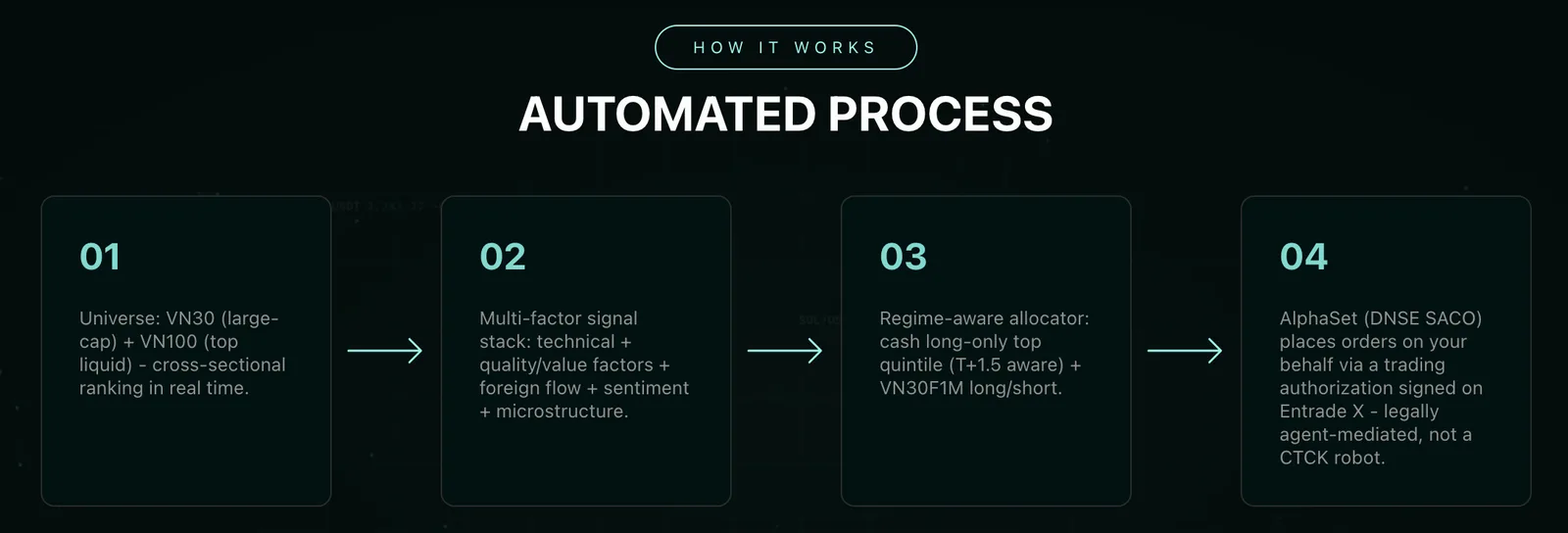
AlphaSet's algorithm scores and ranks tickers in the VN30/VN100 universe based on four signal groups: technical, fundamental factors, foreign institutional flow, and market sentiment. From that ranking, a unified capital allocator splits funds across two segments:
- Equities: Only the strongest-ranked tickers are purchased, traded on a T+1.5 settlement cycle.
- VN30F1M derivatives: Long or short positions based on trend direction, with approximately 5.4× leverage. For derivatives trading, the engine combines trend signals and technical signals to determine when to go long and when to go short.
Every decision is data-driven; each position carries a predefined stop-loss and is executed automatically — unaffected by emotion or rumor when the market moves. The goal is not to beat the market in every session, but to accumulate alpha (excess return above the market) consistently across multiple cycles — something that the vast majority of individual investors trading manually find extremely difficult to achieve.
Your assets remain yours. Funds always stay in your own brokerage account; AlphaSet has no authority to withdraw or transfer them. The authorization only permits order placement, and you can revoke it at any time directly within the account management app.
Ready to outperform with AlphaSet?
Activate the AlphaSet strategy today and let our quants manage your exchange sub-accounts automatically.
Activate Alpha Crypto