

Quantitative Trading Report
Overview of quantitative trading, real-world performance figures, and the opportunity for individual investors in Vietnam.
Scope: Global + Vietnam
1. Definition
Quantitative Trading (Quant Trading) is a financial trading approach that uses numerical data, mathematical–statistical models, and computer algorithms to identify and execute trades systematically and automatically, independent of human emotion or intuition.
Quant trading sits at the intersection of three disciplines:
| Discipline | Role |
|---|---|
| Mathematics / Statistics | Build predictive models, validate signals |
| Computer Science | Program algorithms, process big data, automation |
| Finance | Understand markets, trade structure, risk management |
Distinguishing related concepts:
| Concept | Description |
|---|---|
| Algorithmic Trading | Automatically executes orders based on pre-programmed conditions (broader than quant trading) |
| Systematic Trading | Trading by a consistent rule set, with no discretionary intervention |
| High-Frequency Trading (HFT) | A subset of algo trading focused on extreme speed (micro/millisecond) |
| Quantitative Finance | A broader academic field: asset pricing, risk management, derivatives |
2. How It Works – The 5-Step Process
| Step | Name | Description | Common tools |
|---|---|---|---|
| 1 | Data collection & processing | OHLCV prices, fundamental data, alternative data (satellite, social media, credit card), macro | Python, SQL, Bloomberg, Refinitiv |
| 2 | Alpha Research | Analysis to find signals that predict price movements — "alpha" | Pandas, statsmodels, Jupyter |
| 3 | Backtesting | Run models on historical data; assess Sharpe ratio, drawdown, win rate | Backtrader, Zipline, QuantConnect |
| 4 | Optimization & risk management | Position sizing, stop-loss, drawdown control, stress testing | PyPortfolioOpt, custom risk engine |
| 5 | Deployment & monitoring | Bots auto-execute orders 24/7; alerting systems for anomalies | Interactive Brokers API, FIX protocol, co-location |
3. Core Algorithms
| Algorithm | Principle | Typical applications | Time horizon |
|---|---|---|---|
| Mean Reversion | Prices that deviate from their historical mean tend to revert | Pairs trading, spread trading, equity L/S | Hours – days |
| Momentum / Trend Following | Rising assets tend to keep rising over the short-to-medium term | Managed futures (CTA), cross-asset momentum | Weeks – months |
| Statistical Arbitrage | Exploit temporary mispricings between highly correlated assets | ETF arb, index arb, basket trading | Seconds – days |
| High-Frequency Trading (HFT) | Speed is the edge — execute millions of orders per second | Market making, latency arb, order flow prediction | Micro/millisecond |
| Machine Learning | Detect nonlinear patterns in large datasets | Signal generation, NLP on earnings calls, alt-data processing | Varies |
| Execution Algorithms | Optimize execution to minimize market impact | VWAP, TWAP, POV, Implementation Shortfall | Intraday |
4. Global Development History
4.1. Timeline of Key Milestones
| Year | Event | Significance |
|---|---|---|
| 1952 | Harry Markowitz – Modern Portfolio Theory | Mathematical foundation for portfolio optimization |
| 1973 | The Black-Scholes model | Revolutionized options pricing, paving the way for quant finance |
| 1978 | Jim Simons founds Monemetrics | The origin of the most successful quant fund in history |
| 1982 | Renamed Renaissance Technologies | Laid the groundwork for the quant hedge fund movement |
| 1988 | Medallion Fund launches; D.E. Shaw founded | Two names that would define the quant industry |
| Late 1980s | Statistical arbitrage emerges at Morgan Stanley | Spread quant strategies across Wall Street |
| 1993 | Medallion Fund closes to outside investors | Serves only internal employees from this point on |
| 2000s | HFT booms on technology and deregulation | Speed becomes the key competitive edge |
| 2001 | Two Sigma founded | The "tech company + finance" model is born |
| 2007 | "Quant Quake" — many quant funds crash simultaneously | A lesson in systemic risk and correlation |
| 2010s | Machine learning integrated into alpha research | Alternative data and AI become the new edge |
| 2020s | LLMs and generative AI enter quant trading | The line between quant and AI research blurs |
4.2. Global Market Size (Algorithmic Trading)
| Metric | Figure | Source |
|---|---|---|
| 2024 market value | ~$21B (Grand View) / ~$51B (Straits Research) | Grand View Research, Straits Research |
| 2025 forecast | ~$23.5B | Grand View Research |
| Expected CAGR through 2033 | 10–13%/year | Multiple sources |
| % of US equity volume executed by algos | >75% (2025) | Nurp.com |
| North America market share | ~33.6% | Grand View Research |
| Total global hedge fund AUM (2024) | ~$4.8 trillion | With Intelligence |
| 2029 hedge fund AUM forecast | >$5.7 trillion | With Intelligence |
5. Real Performance Figures
5.1. Major Quant Funds – AUM and 2024 Returns
| Fund | AUM (2025) | 2024 Return | Core strategy |
|---|---|---|---|
| Citadel | ~$397B | ~15% (est.) | Multi-strategy, market making |
| AQR Capital | ~$132.5B | Helix: +17.9% / Apex: +15.1% | Factor investing, trend following |
| Two Sigma | ~$70–84B | Spectrum: +10.9% / AR Enhanced: +14.3% | ML-driven systematic |
| D.E. Shaw | ~$60B | Composite: +18% / Oculus: +36.1% | Stat arb, multi-strategy |
| Renaissance Technologies | Closed to outsiders | RIEF: +22.7% / RIDA: +15.6% / Medallion: ~30% | Mathematics, black-box |
5.2. Medallion Fund – A Historic Record (net of fees)
| Period / Year | Return (net of fees) | Note |
|---|---|---|
| 1988–2018 (annual average) | ~39%/year | ~66%/year before fees |
| 2000 (Dotcom crash) | +56.6% | Market fell –9% |
| 2008 (financial crisis) | +74.6% | S&P 500 fell –37% |
| 2020 (COVID crash) | +76% | Best recent year |
| Losing years (1988–2022) | Only 1 (1989, small) | Win rate ~97% |
| $100 invested in 1988 | ~$398.7M by 2018 | CAGR ~63.3% |
Note: The Medallion Fund has been closed to outside investors since 1993, serving only Renaissance employees. It is the outlier of all outliers in investment history.
5.3. Real Returns – Individual Investors (Retail Quant)
| Category | Realistic expected return | Note |
|---|---|---|
| Beginners (0–2 years) | Usually losses or ~0% | 84% of crypto traders lose in their first year |
| Skilled retail quant | 10–20%/year | A realistic benchmark for serious practitioners |
| Elite retail quant | 20–40%/year (with light leverage) | Rare; requires a true edge and strong risk management |
| Institutional quant fund (average) | ~4–15%/year (net) | 2014–2019: ~4.2%/year on average |
| Top-tier quant fund | 15–40%/year | Only names like D.E. Shaw and Citadel's top strategies |
Reality: Most retail traders using quant strategies still underperform the market benchmark after fees and taxes. A real edge is very hard to find and sustain.
6. Fund Participation
6.1. Types of Funds Engaged in Quant Trading
| Fund type | Examples | Quant strategy | Objective |
|---|---|---|---|
| Pure quant hedge fund | Renaissance, Two Sigma, D.E. Shaw | Black-box, stat arb, ML-driven | Absolute alpha, uncorrelated returns |
| Multi-strategy hedge fund | Citadel, Millennium, Point72 | Quant as one component within portfolio pods | Diversification across many strategies |
| CTA (Commodity Trading Advisor) | Man AHL, Winton, Campbell | Trend following, managed futures | Crisis alpha — profits when markets fall |
| Factor / Smart Beta funds | AQR, BlackRock factor funds | Systematic factor investing (value, momentum, quality) | Harvesting risk premia over the long run |
| Market making firms | Virtu Financial, Jane Street, Optiver | HFT, options market making | Bid-ask spread, high volume |
| Proprietary trading firms | IMC, Flow Traders, Hudson River Trading | HFT, stat arb, ETF arb | Profit from their own capital |
| Asset managers with quant integration | BlackRock Aladdin, Vanguard, Fidelity | Quant for execution, risk management | Optimize trading costs, manage risk |
6.2. Who Allocates to Quant Funds – and How Much?
| Investor (LP) | Allocation size | Why they choose quant |
|---|---|---|
| Pension Funds | ~$1.3 trillion into hedge funds overall (US) | Uncorrelated returns, portfolio protection |
| Endowments | Harvard and Yale often allocate 15–30% to alternatives | Long-term alpha, diversification |
| Sovereign Wealth Funds | GIC, ADIA, Norges Bank allocate heavily to quant | Large scale requires a systematic approach |
| Family Offices | Flexible; typically $10M–$500M per fund | Wealth preservation, diversification |
| Fund of Funds | Aggregated from many smaller LPs | Access to closed funds, diversification |
6.3. Allocation Trends 2024–2025
- 36% of institutional allocators plan to deploy new capital into hedge funds in 2024.
- 43% will invest opportunistically when conditions are favorable.
- Top multi-strategy funds deployed ~$20B across 50+ third-party managers in H1 2024 alone.
- After quant funds proved their protective value in the 2022 crash (stocks and bonds falling together), major pension funds such as CalPERS and Ohio PERS increased their allocations.
- Quant specialist: AQR added nearly $20B in H1 2025.
7. The State of Quant Trading in Vietnam
7.1. Market Infrastructure
| Factor | Status |
|---|---|
| KRX trading system | Officially launched May 2025 at HOSE — a major infrastructure upgrade after 10 years |
| Liquidity (Jul 2025) | |
| Market reclassification | FTSE Russell upgrade from Frontier → Secondary Emerging Market on Sep 21, 2026 |
| Settlement | T+2 — limits capital turnover; no intraday shorting |
| Price band | ±7%/day at HOSE — affects certain strategies |
| Derivatives | No stock options; VN30 futures exist but liquidity is still limited |
7.2. Vietnam-Specific Challenges
| Challenge | Impact level |
|---|---|
| Lack of high-quality historical tick/orderbook data | High — hard to backtest accurately |
| T+2 settlement and no free margin shorting | High — constrains strategies |
| Price manipulation in mid/small-caps | Medium — causes false signals |
| No dedicated legal framework for algo trading | Medium — latent legal risk |
| Small quant community, little professional exchange | Medium — lack of benchmarking |
| Limited derivatives toolkit | Low–Medium — improving |
7.3. Pioneers in Vietnam
| Organization | Type | Activity |
|---|---|---|
| AlgoTrade VN | Domestic algo trading platform | Provides systems; recommends beta 0.8–1.2 to the VN market |
| VietQuant | Quantitative asset management | Applies scientific methods to asset management |
| Klarda Digital | Fintech startup | Dashboard + API for quantitative investment management |
| Major brokerages (SSI, VPS, MBS) | Broker / sell-side | Quietly building in-house quant capabilities |
| Crypto bot traders | Individual retail | A large community using 3Commas, Freqtrade, and custom Python bots |
Opportunity: Vietnam is at an "early mover" stage — the market still has many anomalies, quant competition is thin, and the 2026 Emerging Market upgrade will draw in large institutional flows.
8. Stakeholder Map
| Group | Who they are | Needs | Goals | What they pursue |
|---|---|---|---|---|
| Quant Researcher | PhDs in math, physics, CS | Clean data, computing power, research freedom | Find new alpha, build models with a real edge | Intellectual challenge + high compensation (7–8 figures USD/year at top firms) |
| Quant Developer | Strong software engineers | Low-latency infra, clean codebase, close collaboration with researchers | Implement to spec, optimize execution | Engineering challenge + competitive pay |
| Portfolio Manager (buy-side) | Manages portfolios at a hedge fund | High Sharpe, low drawdown, easy to scale | Stable alpha that satisfies LPs | AUM growth + performance fees + reputation |
| Institutional Investors (LP) | Pension fund, endowment, sovereign wealth | Stable returns, uncorrelated with traditional markets | Preserve and grow capital over the long term | Risk-adjusted returns + true diversification |
| Retail Quant Trader | Programmers, students, self-taught traders | Easy-to-use platforms, data, community | Passive income, improving their edge | Financial freedom + knowledge + personal challenge |
| Fintech / Data Vendor | Bloomberg, QuantConnect, AlgoTrade, Klarda | Paying customers, partnerships | Monetize data and infrastructure | Market share + recurring (SaaS) revenue + network effects |
| Sell-side (Broker / Bank) | Goldman, Morgan Stanley; VN: SSI, VPS | Trading fees, flow volume | Grow volume, retain institutional clients | DMA, execution services, prime brokerage |
| Regulator | SSC (UBCKNN), HOSE, HNX | Stable, transparent markets free of manipulation | An appropriate legal framework as the market matures | Balancing innovation and investor protection |
9. Trends and Outlook
| Trend | Content | Implication |
|---|---|---|
| Quant goes AI | LLMs read earnings calls and analyze sentiment; RL for execution | The quant/AI boundary blurs; barriers to entry rise |
| Democratization | Python, cloud computing, and open data lower the cost of building strategies | Retail traders in Vietnam can build a quant system for a few million VND |
| Alpha grows scarcer | Many users on the same strategy → alpha gets "arbed away" | Constant innovation is required; regime change breaks old models |
| Alternative data ascendant | Satellite imagery, credit card data, app downloads, LinkedIn job postings | Differentiated data is the source of differentiated alpha |
| Vietnam — a window of opportunity | New KRX + 2026 Emerging Market upgrade + rising liquidity | A rare transition: many anomalies, little competition — early-mover advantage |
10. From Complexity to a Solution: AlphaSet
This entire report points to one truth: quant trading is a game played at the intersection of three fields (math – programming – finance), through a complex 5-step process, on expensive data infrastructure, in pursuit of an "edge" that is extremely hard to find and even harder to sustain.
As Section 5.3 makes clear: most individual investors lose money in their early years, with 84% of crypto traders losing in their very first year.
To build a profitable quant system on your own, you typically have to spend thousands of hours studying math and statistics, programming, and finance — then collect your own data, research alpha, backtest, manage risk, and run bots 24/7. A natural question arises:
"Is there a way to reap the full benefits of institutional-grade quant trading without having to learn and build all of it yourself?"
That is exactly why AlphaSet was created.
What is AlphaSet?
AlphaSet is a platform that delivers institutional-grade quant strategies to every individual investor — no experience required, and no need to watch the market 24/7.
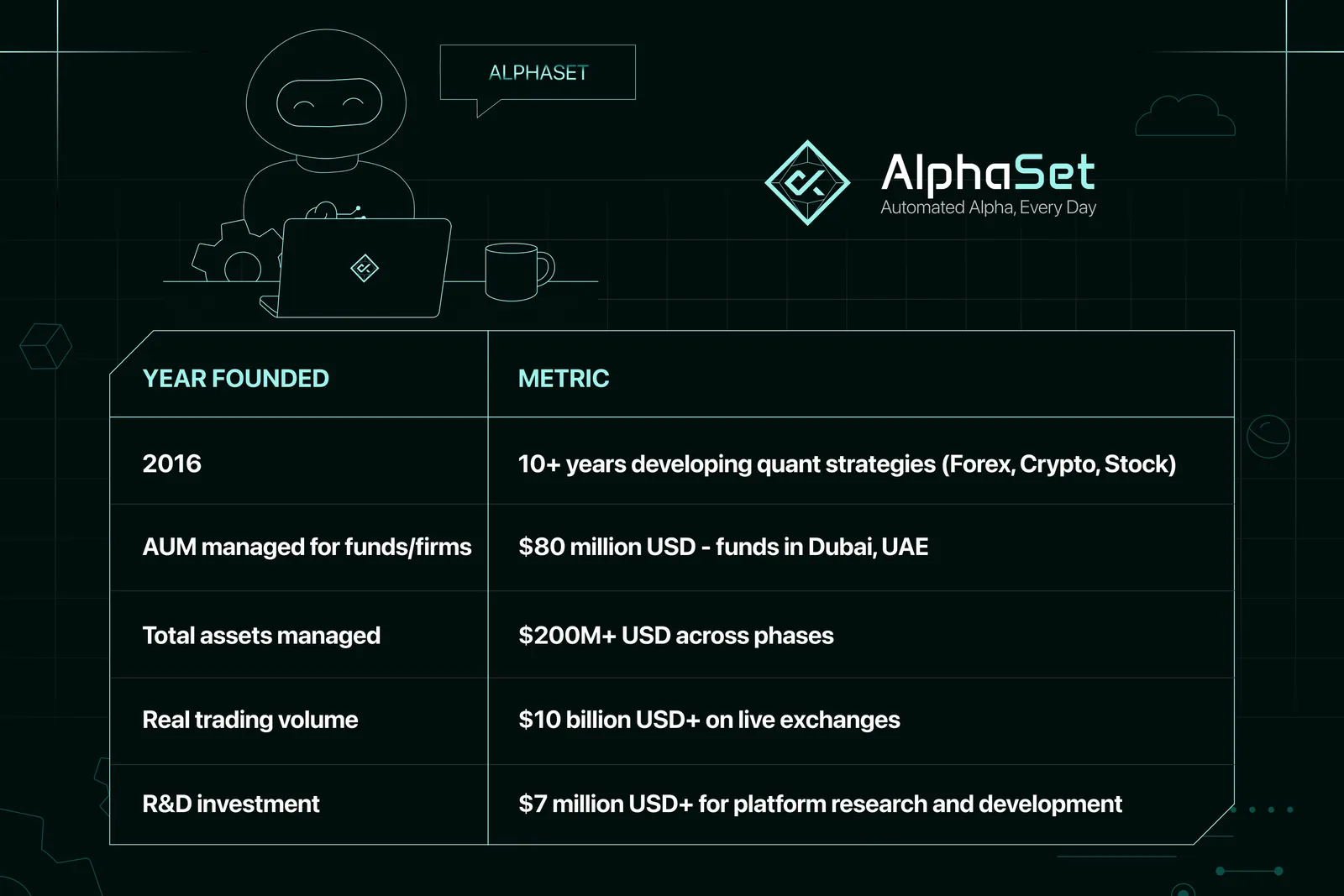
AlphaSet Trades Automatically for You, 24/7
Every complex step described in this report is already handled for you by AlphaSet.
| Trading on your own | Trading with AlphaSet |
|---|---|
| Study math, statistics, programming, and finance for years | A proprietary Quant Engine already aggregates 100+ signal sources |
| Collect & clean data yourself (Step 1, Section 2) | A real-time data infrastructure is already built and running |
| Research alpha, backtest, and optimize risk yourself (Steps 2–4) | Strategies have passed 4 validation stages: backtest → forward-test → live sim → deploy |
| Program and babysit bots 24/7 (Step 5) | The engine places orders automatically and auto-rebalances the portfolio every minute |
| Worry about handing capital to a third party | Non-custodial: your funds always stay in your own exchange account; a "trade-only" API with no withdrawal rights |
| Face the same loss risk as 84% of beginners | Institutional-grade risk management is built into every strategy |
The 4 Strategies (Alphas)
AlphaSet currently offers the following 4 strategies:
| Product | Strategy type | Supported exchanges | Minimum capital | Risk level (proportional to profit potential) |
|---|---|---|---|---|
| Alpha Crypto | Swing/Scalp Long/short on Top 100 crypto — futures, default 3x leverage | Bybit, BingX, Binance | $1,000 | Medium – High |
| Alpha Stock | Multi-segment quant on VN cash equities (HOSE/HNX) & VN30F1M derivatives | DNSE (via SACO authorization) | $1,000 | Medium – High |
| Alpha Gold | Long/short XAU across multiple timeframes — ~10–30 trades/day | Exness, FM | $1,000 | Medium – High |
| Alpha Funding | Funding-rate arbitrage — market-neutral, lowest risk | Bybit, BingX | $500 | Low |
Why Choose AlphaSet?
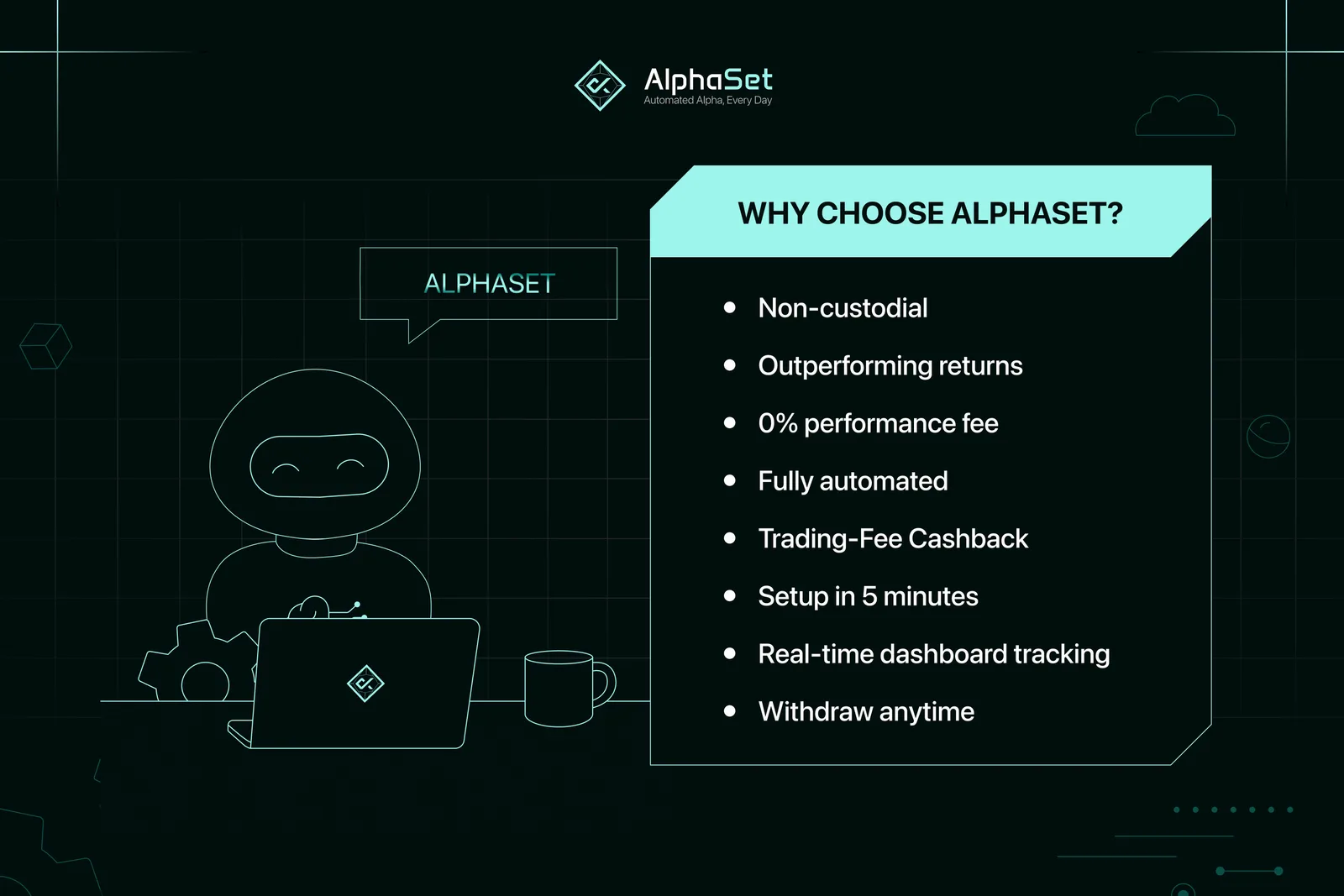
- No performance fee — you keep all the profit your strategies generate.
- Institutional-grade security: AES-256 encryption, end-to-end; every change to the live environment requires approval.
- Strategy diversification: 4 automated trading strategies (4 Alphas). Each is designed for different market conditions and risk appetites.
You don't need to be a Renaissance mathematician to benefit from quant trading. Let AlphaSet handle the complex part for you! Join the waitlist to receive a Pro plan worth $99, free, at https://alphaset.org/en/waitlist
Disclaimer: All trading carries risk; past performance does not guarantee future results. Nothing in this report constitutes investment advice.
Sources: Grand View Research, Straits Research, Hedgeweek, QuantifiedStrategies.com, Quartr (Medallion Fund), QuantStart, With Intelligence, AlgoTrade VN, Vietnam-Briefing, Tiger Research, IMARC Group.
Ready to outperform with AlphaSet?
Activate the AlphaSet strategy today and let our quants manage your exchange sub-accounts automatically.
Activate Alpha Crypto