

Introducing the 3 Operational Layers of the AlphaSet Quant Engine
When you activate an Alpha strategy and the first order is executed, a complex chain of processes unfolds behind the scenes in a matter of milliseconds. To help you understand how AlphaSet works, this article explains the three-layer architecture of the Quant Engine.
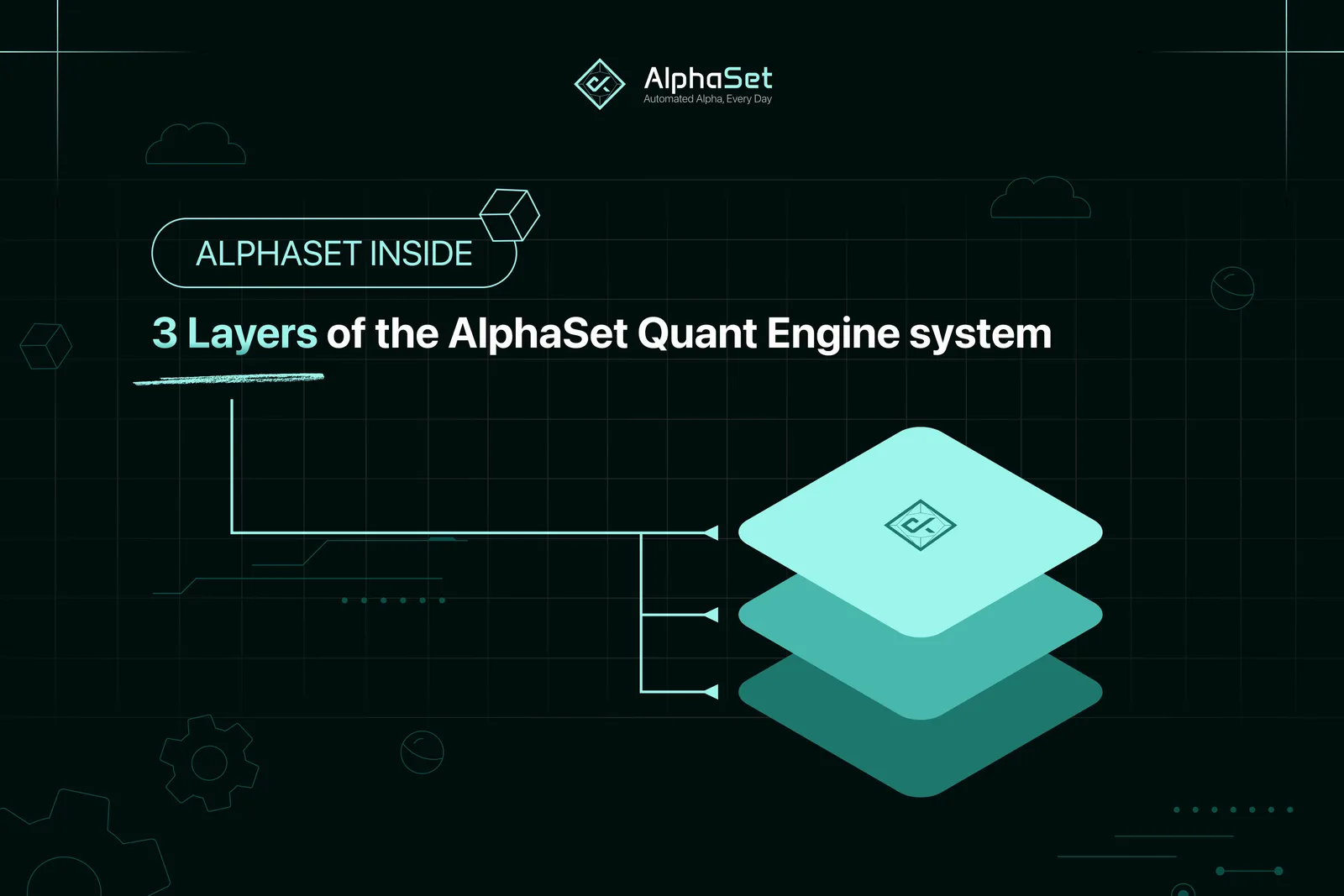
The three layers are: Signal Collection and Processing, Portfolio Optimization, and Real-Time Order Execution. They operate sequentially like a pipeline, yet continuously feed back into one another for ongoing adjustment.
Layer 1: Signal Collection and Processing
This is the entry point of the entire system. Its job is to answer one question: What is the market saying?
Signals are collected from multiple sources simultaneously.
For the Alpha Crypto product, data includes price and volume from exchanges, on-chain data such as coin inflows and outflows to and from exchanges, market sentiment from social media and forums, order book depth, and microstructure indicators such as the bid-ask spread.
For the Alpha Gold product, the inputs are macro data: the US Dollar Index (DXY), real interest rates from the US bond market, and capital flows into gold ETFs.
Raw data cannot be used directly. Before becoming a signal, it must go through normalization (so that indicators on different scales can be compared), noise filtering (removing abnormal fluctuations that do not reflect true market conditions), and aggregation (combining multiple indicators into a single score that reflects the true state of an asset). For Alpha Crypto, the output of this data layer is a scoring table for 100 tokens, updated continuously. Tokens with high scores are strong across all dimensions in aggregate. Tokens with low scores are weak.
Layer 2: Portfolio Optimization
Knowing which tokens are strong and which are weak is not enough. The next question is: What is the optimal way to allocate capital?
This layer uses mathematical optimization algorithms — specifically convex optimization and Mean-Variance Optimization (MVO) — to calculate the optimal weight for each position. The objective is not only to maximize expected returns, but also to keep risk at an acceptable level while accounting for correlations between assets.
For example: if BTC and ETH have a correlation of 0.95 (moving almost in lockstep), holding large positions in both does not genuinely reduce risk. The optimization layer adjusts weights to achieve real diversification, not merely nominal diversification.
This layer also integrates regime detection — a system that classifies which of four fundamental market states is currently in effect: uptrend, downtrend, low-volatility sideways, and high-volatility sideways. Each state calls for different optimal parameters for sizing and risk tolerance.
Layer 3: Real-Time Order Execution
This layer takes the target portfolio from the optimization layer and executes it on the exchange as efficiently as possible.
This is not a trivial step. Poor execution can erode a large portion of theoretical profits. Execution challenges include: slippage (the actual fill price differs from the intended price), market impact (large orders move the price against themselves), and order sequencing (whether to close existing positions before opening new ones, or vice versa).
AlphaSet's execution layer addresses these issues by splitting large orders into multiple smaller ones (to reduce market impact), timing execution based on current order book depth, and prioritizing maker orders to save on transaction fees whenever conditions allow.
Why All Three Layers Are Necessary
No link in this chain can be removed if the goal is to build a rigorous strategy that maximizes returns and minimizes risk. Without a strong signal layer, you are optimizing on noisy data. Without the optimization layer, you know what the market is saying but not what the right course of action is. Without strong execution, a theoretically sound strategy still underperforms in practice due to transaction costs and slippage.
What sets AlphaSet apart from simple bots on the market is that all three layers are built to the same technical standard as professional quantitative funds, yet deployed at a scale suited to individual investors.
These three layers run continuously — they never sleep, never get distracted. When a new signal emerges at 3 AM, the signal layer updates immediately, the optimization layer recalculates, and the execution layer rebalances the portfolio. No action required from you.
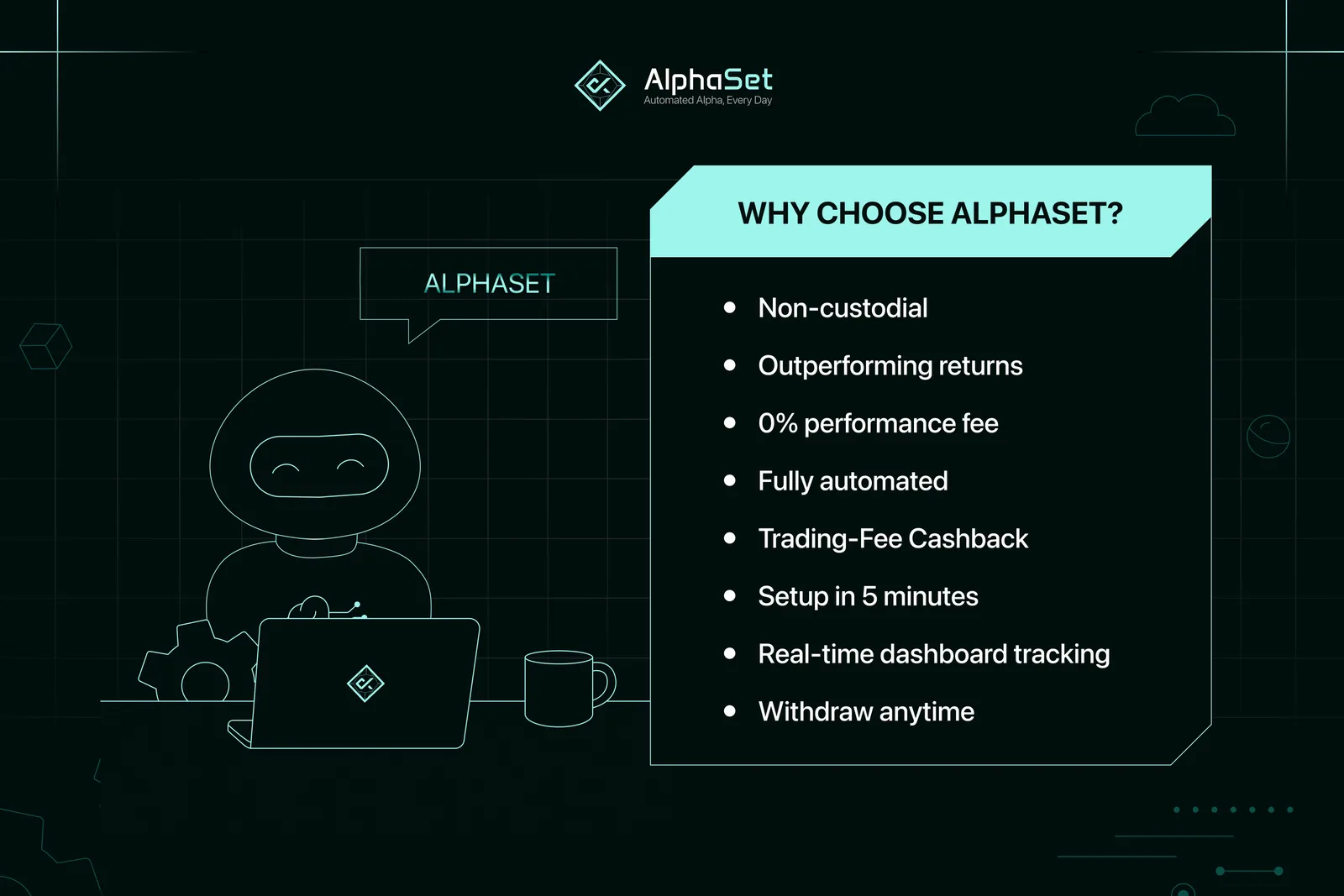
Learn more about how AlphaSet operates and join the waitlist at https://alphaset.org/en/waitlist
Ready to outperform with AlphaSet?
Activate the AlphaSet strategy today and let our quants manage your exchange sub-accounts automatically.
Activate Alpha Crypto